noteworthy
At the end of a warm July day spent swimming and playing games at a bucolic camp in the Maine woods, young people from the Middle East, Southeast Asia, the United Kingdom, and the United States gather to probe their deep cultural and ideological divides.
It’s not supposed to be easy—and it isn’t. There are tears. There is shouting.
At times, participants must leave the room to regain composure. Staff gently guide them back to the discussion. As she sits in the center of the maelstrom of emotion drawn from generations of trauma, facilitator Devany Pitsas, BA ’22, knows in her bones that she’s exactly where she’s supposed to be.
There are breakthroughs in that room, too. Condemnation turns to curiosity. Trust begins to grow.
A program manager for the nonprofit Seeds of Peace, a global organization focused on building more just societies by encouraging young people to lead with empathy and respect, Pitsas helps bring together high school students from around the world to develop conflict-resolution skills. She and her colleagues create space for young people from opposing sides of war and complex historical animosity to channel their raw feelings into dialogue—as if by alchemy. It can be draining work for both students and facilitators. But if done right, the effort Pitsas is making to train young leaders to listen and engage with those who hold different viewpoints will have a ripple effect on their communities and, perhaps, the world.
“It’s a fascinating and magical thing to be in the room to see those conversations, those ‘aha’ moments” when understanding is built, Pitsas says. She had her own moment of transformation a handful of years ago as a global & cultural communication major in class with Suffolk University Professor Shoshana Madmoni-Gerber.
In her Conflict, Negotiation, and Mediation course, Madmoni-Gerber, chair of the Department of Communication, Journalism & Media and a certified mediator, gives students the tools to have tough conversations and move toward solutions in their personal and professional lives. The techniques they practice apply to everything from roommate disagreements to organizational conflict and international negotiations.
Madmoni-Gerber teaches her students that even in a business negotiation, their work goes beyond the bottom line. “There are always intangibles, there are feelings involved,” she explains.
Counterintuitively, learning to be an effective mediator can require students to repress their natural urge to be helpful. Their role is not to be advocates or therapists, but to help two parties speak for themselves, says Madmoni-Gerber. “It’s a facilitator’s role to help two sides get to a resolution that’s driven by the participants.”
She and her students have no trouble finding conflicts to study. Together, they dissect text exchanges between friends and disputes with landlords. They follow current events, from government policy debates to union strikes. Madmoni-Gerber also brings in experts from diverse fields—including alumna Crystal Chandler, BA ’15, who shares her experience leading community mediation in the context of racial conflict, as well as Madmoni-Gerber’s sister, Galit Madmoni-Landau, a seasoned labor economist and lawyer with extensive experience in public sector negotiations within Israel’s healthcare system.
When Pitsas visited Madmoni-Gerber’s class last fall, the way she spoke about her rewarding experience as a mediator immediately resonated with junior Samuel Benson. “It opened my eyes to another field I could possibly go into,” says Benson, a global & cultural communication major who wants to pursue a career in family law someday.
He was drawn to family law at a young age, he says, after learning how different conflict resolution styles can create strain within a family during his parents’ divorce. In Madmoni-Gerber’s course he’s learning how to view that experience, and other conflicts large and small, in more constructive terms.
“We’re learning that both parties have to be in the mindset of, ‘How can I win this?’ But also, ‘How can they win this, as well?’ A win/win is what preserves the relationship,” says Benson.
Pitsas says Madmoni-Gerber’s vulnerability and willingness to share her own experiences as a mediator helped illuminate her path forward. She recalls thinking, “I can see myself making change by learning this.”
She earned her mediation certification soon after graduation and began working in the court system before joining Seeds of Peace. Becoming a mediator is a decision that fills Pitsas with gratitude for what she learned at Suffolk and a sense of purpose—not just for addressing global tensions, but also for easing partisan strife here at home.
“In the US we’re not just mediators between conflicts in other regions. We have our own issues,” says Pitsas. “Having the tools to help move these conversations forward is what brings me hope.”
Return to Table of Contents
spring 2025
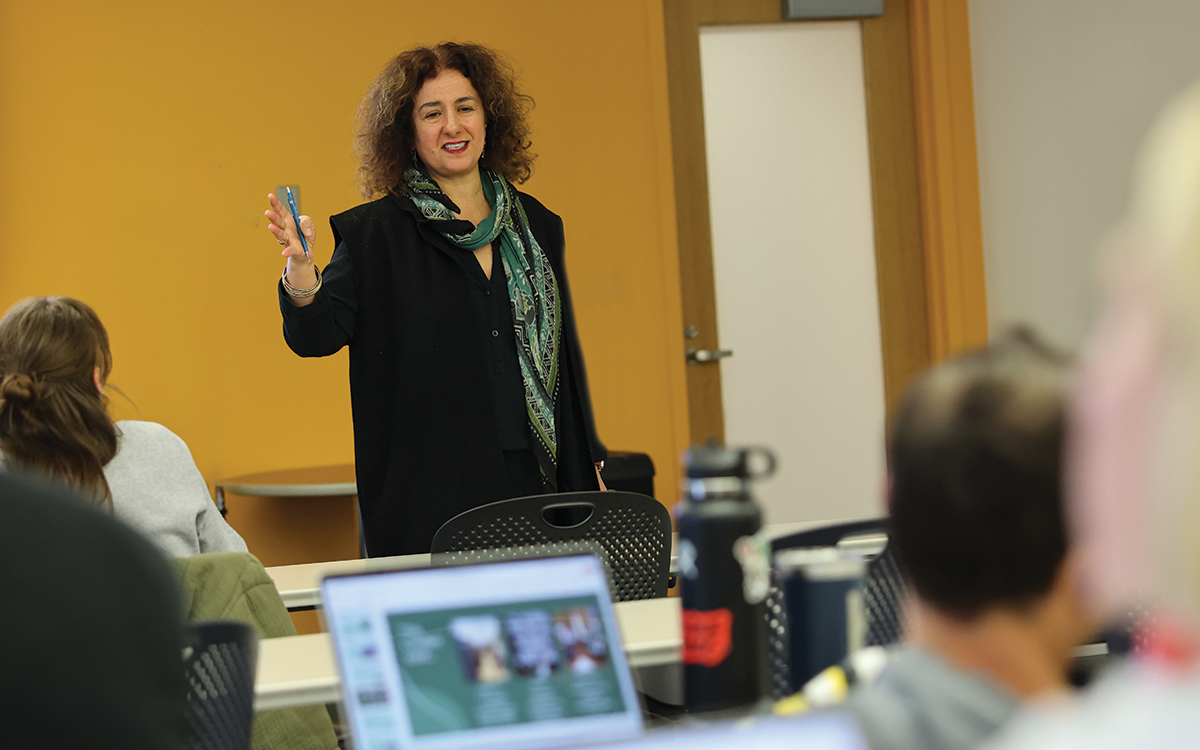
In her Conflict, Negotiation, and Mediation course, Professor Shoshana Madmoni-Gerber shares strategies for resolving conflicts around the dinner table, in the office, and on the world stage. Photograph by Michael J. Clarke
By Andrea Grant

Meditation 101
Understand cultural context: Madmoni-Gerber explores mediating disputes in more traditional cultures. Compared to the US, where complete detachment is the norm, her Mizrahi Israeli family members, for example, prefer to have a connection with their mediator.
Maintain a neutral stance: One of the hardest things for mediators to unlearn is the inclination to suggest solutions—but participants need to do that work, she says.
Identify each party’s true interests and goals: This can include both tangible and intangible trade-offs. One of the most common? Many parties in a dispute are seeking an acknowledgment or an apology.
Know when to take a break: When parties are at an impasse, time-outs allow tempers to cool and create an opportunity for the mediator to reframe the discussion to the parties separately.
One tip Madmoni-Gerber has for those broaching a fraught topic with their families: “Lead with compassion. If appropriate, explain that the values you hold stem from the compassion you learned from your family. That can remove some of the sting of feeling judged and help create willingness to engage.”