Perched atop a jagged black volcanic rock, Suffolk University public relations major Lauren Rivers, Class of 2027, struggled to shield the page of her sketchbook from the first drops of a rain shower as wind swept across the otherworldly landscape, unimpeded by trees. Centuries of deforestation following its Viking settlement left Iceland with very few trees, an early and enduring example of humanity’s impact on nature.
Still, throughout the island nation Earth’s raw power is on constant display—from the geysers and waterfalls that fascinate tourists, to the geothermal energy harnessed from underground that powers much of the country, to the flowing lava threatening to engulf a coastal fishing town in its path.
This August, students in Suffolk’s academic travel seminar, A Case Study in Sustainability: Iceland, sifted through the country’s black sand beaches, warmed themselves inside the greenhouses that support food production on an island known for harsh weather and winters spent in near-total darkness, and journeyed through icy waters to observe sea ice from the rapidly melting Breiðamerkurjökull glacier. Now they’re bringing insights from each one of those transformative experiences back to Boston to inform a semester-long interdisciplinary study of sustainability.
Co-taught by Director of Environmental Science & Studies Hayley Schiebel and Graphic Design Professor Kristen Mallia, the course features a different topic each week, such as the pros and cons of ecotourism and how a country that relies heavily on fishing can adapt to warming oceans. Firsthand knowledge of Iceland’s extremes provides an ideal launching point for discussion across disciplines, says Schiebel: “Iceland is one of the most sustainable countries, with lessons that apply to students in virtually any major.”
Return to Table of Contents
Photographs: Professor Kristen Mallia
By Andrea Grant


The group’s boats navigated chunks of ice from the melting Breiðamerkurjökull glacier that fill the waters of Jökulsárlón Glacier Lagoon in Vatnajökull National Park.


Left: Getting up close with a chilling reminder of climate change, senior Alessandra Nagarajan, an environmental studies major, examined a piece of glacial ice.
Right: Iceland generates 85% of its energy from domestic renewable sources and aims to be carbon neutral by 2040. Suffolk students got an insider’s look at green hydropower and geothermal energy production, as well as an innovative program called Carbfix that traps harmful CO₂ emissions inside basalt rocks.
Above: For centuries, historic turf houses, like this one in Selfoss, used earthen walls and roofs as insulation against the harsh climate.
Left: Students visited Haukadalur Geothermal Field, home to the now-dormant Great Geysir—the world’s first documented geyser, for which all geysers are named—as well as Strokkur, which erupts every five to ten minutes.


Left: At Reynisfjara Black Sand Beach near the southern Icelandic town of Vík í Mýrdal, Environmental Science Professor Hayley Schiebel discussed coastal geology, wave action, erosion—and what gives the sand its distinctive color.
Right: Students visited the Skálanes Nature and Heritage Centre to learn how conservation is woven throughout Icelandic society—including in the production of wool, a renewable and biodegradable fabric. “Wool clothing here is a lifetime commitment, not fast fashion,” says Professor Kristen Mallia.


Left: Volcanic rocks—like these found on a hike through Hallormsstaður National Forest—make up much of Iceland’s unique landscape, and can be turned into eco-friendly “lava bricks” used in sustainable design.
Right: Sarah Goobic, Class of 2027, paused at a café in the East Icelandic town of Seyðisfjörður. Professor Kristen Mallia encouraged students to explore the area during a scavenger hunt modeled on French theorist Guy Debord’s concept of a dérive. “French for ‘drift,’ it’s an unplanned journey through an urban environment where you let your environment pull you instead of following a set route,” says Mallia. “Architects and urban designers use this exercise to map how spaces actually affect human emotion and behavior.”


01
02
03
04
05
A greenhouse at Móðir Jörð organic farm in East Iceland provides year-round access to locally grown produce.
Tourism to the small island nation, including visitors arriving via cruise ship, has grown by more than 78% over the past decade—a challenge for a nation committed to reducing pollution and energy consumption.
01
02
03
04
05
06
01
02
03
04
05
06
Students got a hands-on lesson in sustainability at the Skálanes Nature and Heritage Centre in East Iceland.
01
04
02
03
05
06
The trip began and ended in the capital city of Reykjavík, which strives to be carbon neutral by 2040.
01
05
02
03
04
06
The trip afforded close-up views of the island's wildlife and livestock, including the revered Icelandic horse, a hardy native breed.
01
06
02
03
04
05
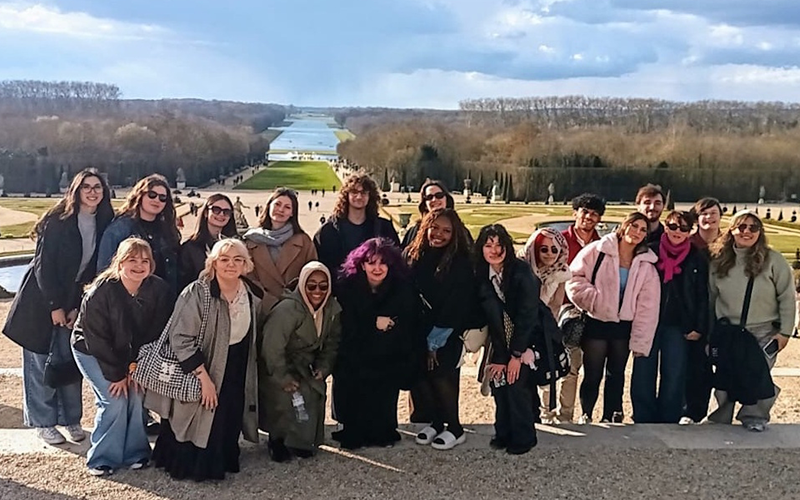
PARIS: “I had never been to Paris, but had participated in the Italy Travel Seminar to Rome/Florence/Milan and the Global Gateway Program to Madrid. This specific trip made me want to stay in France and study abroad there or even move there. Learning about the different revolutions, especially the French, really caught my interest. It made me think differently about my studies [and now I’m] very interested in taking more history classes,” says journalism major Anthony Boyd, Class of 2026.
(Photo by Barbara Abrams)

01
07
02
03
05
06
04
Team iWorks (front row, from left): senior intern Genesis Baez; Moakley Center Associate Director Rae’Niqua Victorine, MAAP ’23, MPA ’23; intern Samanta Torres; Moakley Center Director of Administration Nicole Rivers, MPA ’98; senior job coach Yu Shan Hsieh, BSBA ’23, MPA ’25; iWorks Director Dacia Gallow; job coach Raequan Victorine; (back row) Brendan Burke, director of the Moakley Center for Public Administration.
By Andrea Grant
06


These academic travel programs are managed in collaboration with Suffolk’s Center for International Education and Study Away (CIESA).
Learn more about CEISA.