noteworthy
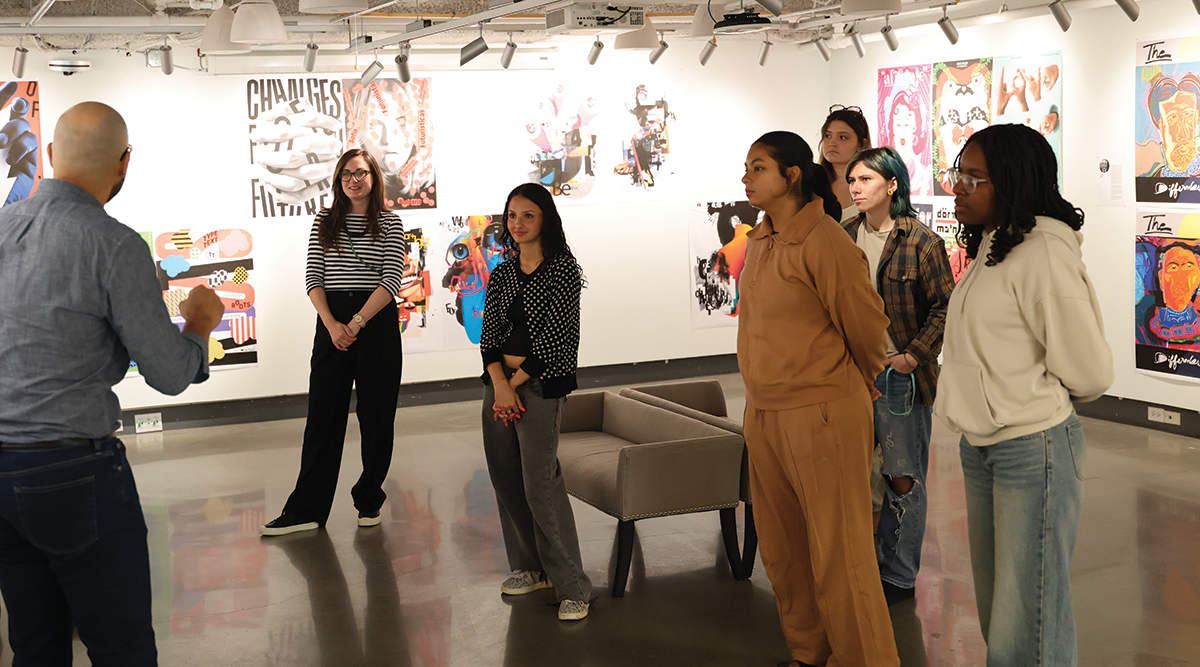
Kayla Schwartz, BFA ’06, has an eye for civic engagement. The interim chair of Suffolk’s Art & Design Department, Schwartz has led course projects centered on social responsibility at the University, including a poster series unpacking constitutional amendments and a get-out-the-vote campaign that took over parts of the Sawyer Building.
With that track record, it’s no surprise she’s received the inaugural Dr. Dulcinea de Correa Rodrigues and Dr. Rachael Cobb Civically Engaged Faculty Fellowship. The new fellowship supports faculty projects that connect classroom learning to civic life, and funds Schwartz’s latest course, Design for Civic Engagement, which launched this fall. It honors the late Dulcinea de Correa Rodrigues—a women’s rights advocate and mother of Suffolk professor Dr. Miguel Rodrigues—who led multiple philanthropic organizations in India, and Associate Professor Rachael Cobb, who specializes in election law and civic participation.
“Corita Kent is my historical backbone for this class,” Schwartz said, referring to the nun and printmaker whose work fusing pop art and political activism made waves in the 1960s. “I think of her as the matriarch of poster design—visually striking, contextually effective, piercing through the noise. I really want to teach from this place.”
Structured to run every other fall to coincide with election cycles, the course unfolds in two parts. During Raising Awareness (September through Election Day), students used their districts as design constraints, creating nonpartisan transit ads, murals, stickers, signage, and social media posts to get out the vote. In the second part, Visual Placemaking (November through December), students identify a local nonprofit, public agency, or small business to pitch a design project—such as a mural or website—benefiting the public, with the goal of eventually bringing some of these concepts to life.
As current political discourse grows more divisive, Schwartz underscores the importance of direct community engagement. She encourages her students to venture into neighborhoods and learn about the districts they design for—who lives there, what they care about, what inspires them. “Getting to deeply know a place, an audience, a context,” she said, “is the starting point of all design.” —Jonathan Ambar
Return to Table of Contents
FALL 2026
Photograph: Michael J. Clarke